You book an appointment at a clinic. You fill in a form on the website, get a confirmation text, the next day someone calls to ask for the same details, and on arrival you find out you needed documents nobody had mentioned. No single screen was wrong. What failed was the service: the set of channels, people and processes behind that appointment. The person who works at this level is the service designer, the professional who designs a whole service, from first contact to what happens backstage.
In this guide I explain what a service designer does, how the role differs from a UX designer, which tools they use (blueprints, journey maps, actor maps), where they work, what is actually known about salaries and how to get into the role.
What you'll learn:
- What service design is, briefly and without jargon
- What a service designer does: research, service mapping, co-design and prototypes
- The differences between a service designer and a UX designer, in a table
- The tools of the trade and when to use each
- Where service designers work and what salary data exists in the US and UK
- How to become a service designer, with or without a design degree
What is service design, in short
A service is something someone does for someone else, and often cannot be touched: a medical appointment, a mortgage, a parcel delivery, a passport renewal. Service design is the discipline that designs it as a whole: what the person using it experiences, what the people delivering it do, and which processes and tools sit in between.
Nielsen Norman Group defines it as the activity of planning and organizing a business's resources to directly improve the employee's experience and indirectly the customer's. The part many people overlook is the first one: a service only works for the user if it also works for the people who deliver it. If the person at the desk has to open four programs to answer one question, the customer waits, and no app will fix that.
Service design grew out of services marketing, where in the early 1980s Lynn Shostack proposed the service blueprint, and later blended with design thinking and user research. Today it is used by banks, hospitals, public agencies and companies of every kind, physical and digital. If you want the picture of the discipline and not only the role, start with design thinking and the Double Diamond, the two process models from which service design takes much of its method.
What a service designer does
The work varies a lot between consultancy, in-house teams and government, but it almost always revolves around three activities that alternate.
Research with users and with staff
A service designer does not only interview customers. They talk to the people who deliver the service: front-desk staff, nurses, clerks, call-center agents. They observe the service as it happens, sometimes by shadowing someone for a day, sometimes by trying it themselves as an ordinary user, known as a service safari. The reason is practical: the costliest problems in a service often sit in a step the customer never sees and the staff take for granted.
The methods are those of user research: interviews, observation, analysis of data and complaints. What changes is the scope: research does not stop at the interface, it covers the whole journey and the people on the other side.
Service mapping
Findings become maps that make visible what is usually invisible: what the user does, what they see and do not see, which people and systems step in at each point, where information or time gets lost. These maps are the main working tool, and we come back to them below. They also help get departments that normally do not talk to each other on the same page: as long as the problem sits on a map, it belongs to everyone.
Co-design and service prototyping
Then you design, and you design together. The service designer runs workshops with users, staff and decision-makers, facilitates idea generation and helps choose which ideas to develop. A service is not prototyped like an interface: you simulate it with a desktop walkthrough (a miniature version of the service on a table), a role-play between "staff member" and "customer", or a small field pilot at one site for a few weeks. You measure what happens and decide whether to extend, fix or stop. The value of this approach is avoiding discovering problems after you have changed the processes of an entire organization.
Service designer vs UX designer
The two roles share methods and vocabulary, and in many teams people do a bit of both. But they are meant for different scales: a UX designer usually works on a digital product, a service designer on a service that product may be part of but does not exhaust.
| UX designer | Service designer | |
|---|---|---|
| Object of the work | A digital product (app, site, platform) | A service, with all the channels and processes involved |
| Who they consider | The product's user | The user and the people delivering the service |
| What they produce | Flows, wireframes, interface prototypes | Journey maps, blueprints, actor maps, service prototypes |
| Where they have impact | On the on-screen experience | Also on organization, roles, rules and back office |
| Measures success by | Usability, conversion, task completion | Quality of the service as a whole, for users and staff |
It is not a hierarchy. A product UX designer can do things a generalist service designer cannot, such as designing an accessible component or a fine-grained interaction. And a service designer often works alongside a product team: their map says which part of the service should become an app, the UX designer designs how. To see where the different profiles sit in a team, see the diagram in UX design team roles, and for the UX designer's work see the guide to what a UX designer does.
The service designer's tools
The tools are almost all maps: different ways of looking at the same service. Each answers a specific question.
| Tool | Question it answers | When to use it |
|---|---|---|
| Customer journey map | What does the person go through, step by step? | After research, to see where the pain points are |
| Service blueprint | What happens backstage at each step? | To find breakdowns, delays and responsibilities |
| Stakeholder map | Who is involved and how much influence do they have? | At the start, to decide whom to listen to and involve |
| Ecosystem map | Who exchanges what with whom (information, money, services)? | When the service depends on several organizations |
| Service prototype | Does it actually work if I try it? | Before changing processes and systems |
Service blueprint
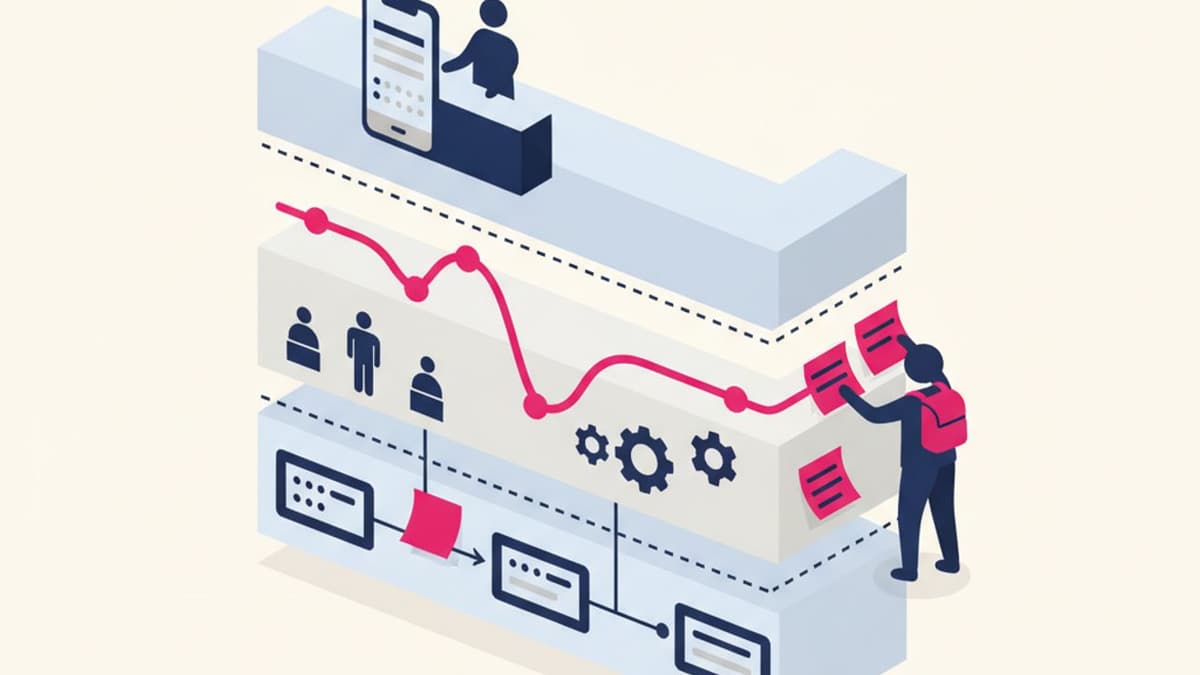
This is the discipline's reference map. It draws the service in horizontal lanes: the user's actions, what the organization does in view (front stage), what it does out of view (back stage), and the support processes and systems, separated by lines that show what the customer can see. The blueprint shows where a service breaks, meaning at which step two lanes fail to talk to each other. The step-by-step method is in the guide to the service blueprint.
Customer journey map
It tells the service from the person's point of view: phases, actions, touchpoints, emotions. It is used to see where the experience gets worse, and it is made twice, for the current journey and for the one you want to achieve. Templates and examples are in the guide to the customer journey map. The difference from the blueprint is that the journey looks only at the customer, while the blueprint adds what sits behind.
Stakeholder map and ecosystem map
The stakeholder map lists all the people and organizations touched by the service and places them by influence and involvement. In service design it helps decide whom to listen to during research and whom to bring into workshops. (Stakeholder management in the project management sense, meaning how to plan the relationship with each one during a project, is a different topic.) The ecosystem map widens the view and draws the exchanges of value between actors: who gives information to whom, who pays whom, what depends on what.
Service prototypes
A service prototype is anything that makes an idea testable without building it: cards and a floor plan on a table, a role-play, a temporary counter, a paper form. Speed matters more than polish. A two-hour prototype made with the staff brings out objections a three-month document would never see.
Where service designers work
Service designers are found mainly in three settings. The first is agencies and consultancies for design and innovation, working on projects for different clients. The second is large organizations with complex services, such as banks, insurers, utilities and telecoms, where the role may also be called "customer experience designer" or "experience designer". The third is government and healthcare. The UK is the clearest example: the GOV.UK Service Manual lists design among the roles a government service team needs, and service designer is an established role in the civil service's Digital, Data and Technology profession, with levels from associate to head of service design.
The variety of titles is worth knowing about: in job ads you will find "service designer", "experience designer", "customer experience designer" and often "UX designer" with a service component. Read the responsibilities, not the label. If the duties include workshops with several departments, process mapping and research with staff, the job is service design even if the title says otherwise.
Salary and outlook
Salary data for service designers is scarce and inconsistent between sources, and it is better to say so than to invent a number. Salary sites have few samples for a role this specific, and they use different categories. Some reference points, to be read as orders of magnitude:
- United States. Payscale reports an average of about $76,000 for a service designer in 2026, while ZipRecruiter shows about $49,000 (July 2026). The two sources disagree by more than 50%.
- United Kingdom. IT Jobs Watch, which tracks pay quoted in job adverts, gives a median of about £55,000 for England in the six months to 31 May 2025. Sample sizes are small.
The honest reading is that starting numbers are similar to other design roles and grow with seniority and the type of organization, but there is no reliable single figure to quote. For the values of other roles, with sources and bands by level, see the guide to UX designer salary.
On outlook: demand depends on organizations realizing they have a service problem and not only a website or app problem. It is a more niche market than UX design and less standardized in titles and required skills. In return, people who combine the two skill sets, interface and service, have a less common profile that is harder to replace.
How to become a service designer
There is no professional register and no mandatory qualification. Degrees and master's programs in service design exist, but many service designers come from UX design, communication design, architecture, sociology, anthropology or from working inside an organization. What interviewers look at is the ability to carry a service project from start to finish.
- Start with research basics. Interviews, observation and synthesis are the material everything else rests on. A user research course helps.
- Learn to map. Make a journey map and a blueprint of a service you really use: an appointment, a delivery, a renewal. You will quickly notice how much you do not know about what happens behind the scenes.
- Practice facilitating. A well-run workshop is a skill in itself. You learn it by running them, even small ones, with colleagues or volunteers.
- Build one complete portfolio case. From problem to research, from maps to prototype and test plan. A single case, but a whole one, is worth more than many partial projects.
Frequently asked questions
What is service design?
It is the discipline that designs a service as a whole: the experience of the person using it, the work of the people delivering it, and the processes, channels and tools that connect them. Unlike product design, it does not stop at the interface but includes what happens backstage.
What is the difference between a service designer and a UX designer?
A UX designer designs the experience of a digital product, a service designer that of an entire service, with several channels, staff and internal processes. The methods overlap, but the outputs differ: wireframes and interface prototypes on one side, blueprints and journey maps on the other.
Do you need a design degree to be a service designer?
No. Dedicated university programs exist, but they are not mandatory and many professionals come from other fields. What matters is being able to run research, map a service, facilitate a workshop and document a portfolio case.
How much does a service designer earn?
There is no solid figure. Public sources are few and diverge: in the US, Payscale and ZipRecruiter differ by about $27,000, and in England job-advert data points to a median around £55,000. Seniority, city, sector and type of organization change the picture a lot. Be wary of anyone promising precise numbers.
What tools does a service designer use?
Mainly maps: customer journey map, service blueprint, stakeholder map and ecosystem map. On top of these come research methods (interviews, observation, service safari), co-design workshops and service prototypes, such as table walkthroughs and role-plays.
Next steps
If you want to make this a specialty, EULE Institute's Service Design course follows exactly this path. It is currently taught in Italian only: the first edition starts on 1 January 2027, with 8 modules and a final project reviewed by a mentor, 100% online, from research with users and staff (service safari, interviews, synthesis) to stakeholder and ecosystem maps, journey maps and blueprints, co-design and workshops, and finally prototypes, pilot plans, accessible public services and quality indicators. There is no English edition open yet.
To build the research base that service design requires, you can start with the User Research course, or with the complete path to becoming a UX Designer.
To go deeper:
- Service blueprint: how to draw the map that links front stage and back stage
- Customer journey map: from theory to template
- Double Diamond: the process model behind many service projects
- UX team roles: who does what in a design team
External sources cited: Nielsen Norman Group, Service Design 101; GOV.UK Service Manual, the team.