
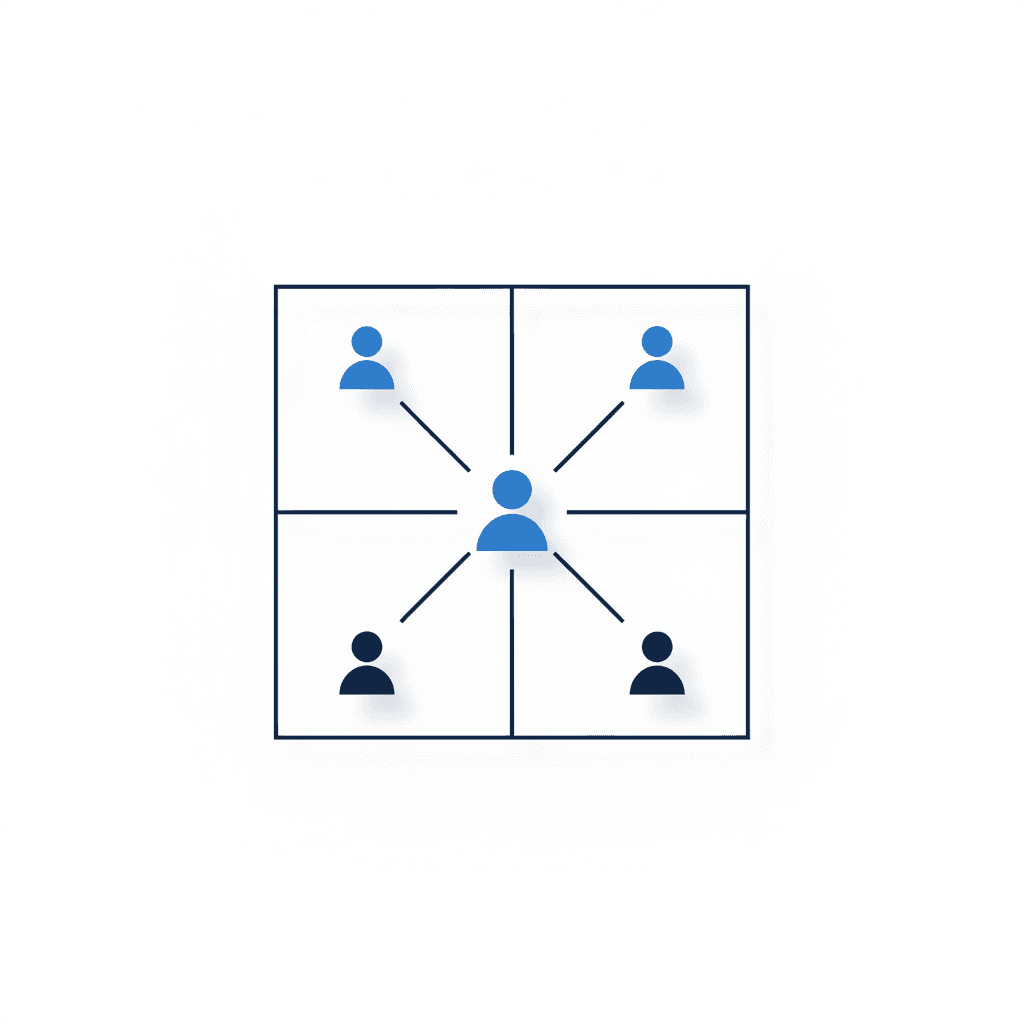
Project stakeholders are the people, groups and organizations that can influence a project or are affected by it, for better or for worse. If you are asking what stakeholders are in plain terms: they are everyone with something at stake in your project. The client who pays for it, the team that builds it, the supplier who delivers the materials, the legal department that has to sign off, the users who will live with the result.
This guide shows you how to identify them, build a stakeholder map with the power/interest matrix, and turn it into an engagement plan. To keep things concrete, we follow one example from start to finish.
What are stakeholders?
The word combines stake (something you stand to gain or lose) and holder (the person who has it). The idea spread through management mostly thanks to R. Edward Freeman's book Strategic Management: A Stakeholder Approach (1984), and it has since become a pillar of project management: the PMI's PMBOK Guide has long devoted a dedicated section to stakeholder management.
A project can hit its deadline and its budget and still be seen as a failure if the people who matter don't get what they expected. Managing stakeholders means managing expectations before they turn into problems.
Four numbers are worth remembering:
- 4 quadrants in the power/interest matrix
- 1 stakeholder register, always kept up to date
- 5 engagement levels, from "unaware" to "leading"
- Day one: stakeholders are identified at kickoff, not halfway through the project
Stakeholder vs shareholder: the difference in one line
A shareholder (or stockholder) owns shares in a company. A stakeholder is anyone with an interest in the outcome, even without owning anything: an employee, a customer, a city council that issues a permit. Every shareholder is a stakeholder, but most stakeholders are not shareholders.
Who are the stakeholders of a project? Internal and external
The first useful distinction is between internal stakeholders, who belong to the organization running the project, and external ones, who sit outside it but feel its effects or can shape it.
Our running example: a company that sells furniture in physical stores decides to launch its own online store. Here is who comes into play.
| Stakeholder | Internal / external | What they want from the project | In the online store example |
|---|---|---|---|
| Sponsor | Internal | Return on investment, staying on budget | The sales director who pushed for the project |
| Project manager | Internal | Clear goals, resources, quick decisions | The person coordinating the agency, IT and the warehouse |
| Project team | Internal | Stable priorities, sustainable workloads | IT, marketing, customer care |
| Affected departments | Internal | That the new channel doesn't create operational chaos | Warehouse and logistics, finance |
| Senior management | Internal | Fit with the company strategy | The CEO |
| Suppliers | External | Clear requirements, on-time payment | Web agency, courier, payment provider |
| Customers / end users | External | A simple, reliable purchase | People buying online |
| Business partners | External | Not being bypassed | Affiliated stores and resellers |
| Regulators and authorities | External | Compliance with the rules | Consumer protection, data privacy and accessibility requirements |
Notice one detail: the resellers don't work on the project, but they may see it as competition and complain to senior management. The least obvious stakeholders are the ones that cause the worst surprises, which is why identification should be done with a method, not from memory.
Why stakeholder management decides whether a project succeeds
Most projects don't fail because of a technical mistake. They fail because of people: a sponsor who loses interest, a department head who blocks approvals, a client who discovers at the end that they had imagined something completely different. Stakeholder management exists to prevent those scenarios.
- More complete requirements: the people who will use or live with the result know things the team doesn't. Involving them early avoids rework.
- Less resistance: people push back harder against changes that are imposed without explanation.
- Faster decisions: if you know who decides what, you don't lose weeks chasing the right signature.
- Risks you can see sooner: a hostile stakeholder is a project risk in every sense and should be handled as one in your risk plan.
It is no accident that communication takes up such a large share of the day for a project manager. Stakeholder management is what makes that communication targeted instead of scattered.
How to identify stakeholders: the stakeholder register
The first tool is the stakeholder register: a table listing who is involved and what you know about each of them. You fill it in when the project starts, usually right after the project charter, which already contains a first list of the main players. Then you keep updating it throughout the project: people change roles, new suppliers join, the balance of power shifts.
How to find every stakeholder
A few questions help you avoid forgetting anyone:
- Who pays for the project, and who approves its phases?
- Who works on the project, even part time?
- Who will use the result every day?
- Which departments will have to change how they work?
- Who can block the project with an opinion, a permit or a veto?
- Who might feel harmed by the outcome?
Put these questions to the sponsor and the first team members, review similar projects that have already closed, and use the kickoff meeting to check that the list is complete.
Stakeholder register template
| Field | What to write | Online store example |
|---|---|---|
| Name and role | Person or group, position | Laura B., head of logistics |
| Internal / external | Relationship to the organization | Internal |
| Expectations | What they expect from the project | Shipping that doesn't require overtime |
| Concerns | What they fear | Order peaks during the holiday season |
| Power | High / low | High: can halt shipments |
| Interest | High / low | High |
| Attitude | Supportive, neutral, opposed | Neutral, with doubts |
| Strategy | How to handle them | Involve her in choosing the courier |
Rule of thumb: the register contains judgments about people ("opposed", "high power"). Treat it as a confidential document for the project manager and the leadership team, not a file to share with everyone.
The stakeholder map: the power/interest matrix
Once you have listed your stakeholders, you need to map them, that is, classify them to decide how much attention each one deserves. The most widely used tool for stakeholder mapping is the power/interest matrix (also known as Mendelow's grid): a plane with two axes.
- Power: how much the stakeholder can influence decisions, resources and the outcome.
- Interest: how much the project affects them and how much they care about how it goes.
The 4 quadrants
High power, high interest: manage closely
These are the key players. You involve them in decisions, update them often and listen to their objections before they become vetoes.
High power, low interest: keep satisfied
They can step in at any moment but don't follow the details. They get short summaries and are consulted on the decisions that affect them.
Low power, high interest: keep informed
The project affects them closely, but they can't decide its fate. Regular updates and a channel for feedback prevent resentment.
Low power, low interest: monitor
Keep an eye on them with minimal effort. Their position can change, though, and then they need to move to another quadrant.
Worked example: the online store launch
| Quadrant | Stakeholders | How you handle them |
|---|---|---|
| Manage closely | Sales director (sponsor), head of logistics | Weekly review, shared decisions on critical points |
| Keep satisfied | CEO, head of finance | One-page monthly report, involvement on budget and payments |
| Keep informed | Customer care, affiliated resellers | Internal newsletter, a dedicated meeting before launch |
| Monitor | General purchasing, HR | Updates only if the project touches them |
A richer variant is the power/influence matrix, or a model that adds a third dimension (urgency, for example). For most projects, though, two axes are enough, and they have the advantage of fitting on a single slide.
Want to practice stakeholder management and project communication on real cases? Take a look at the Project Management course from EULE Institute.
Stakeholder engagement: from the plan to communication
Stakeholder engagement is the set of activities through which you involve stakeholders in the project: informing them, listening to them, bringing them into decisions when needed. The map tells you how much effort to give each one; the engagement plan tells you how.
Engagement matrix: current and desired level
A simple and widely used approach is to rate each stakeholder on five engagement levels: unaware (doesn't know about the project), resistant, neutral, supportive and leading (actively champions the project). For each one you mark where they are today (C, current) and where you need them to be (D, desired).
| Stakeholder | Unaware | Resistant | Neutral | Supportive | Leading |
|---|---|---|---|---|---|
| Sales director | C, D | ||||
| Head of logistics | C | D | |||
| Affiliated resellers | C | D | |||
| Customer care | C | D |
The gap between C and D shows where to work. Not everyone needs to become an enthusiastic supporter: in the example, it is enough for the resellers to move from resistant to neutral, perhaps by showing how online orders picked up in store will bring customers to them as well.
From the plan to communication
For each key stakeholder, the plan states what to communicate, how often, through which channel and who does it. The sponsor gets a summary of status, risks and decisions needed; the team wants operational detail; the resellers get a dedicated meeting. Sending the same message to everyone, in the same format, is the quickest way to make sure nobody reads it.
Stakeholders, RACI and charter: which tool to use when
These three tools are often mentioned together, but they answer different questions.
Project charter
- When: at the start
- Question: who are the main players?
- Contains a first high-level list
Register and power/interest matrix
- When: from the start through the whole execution
- Question: how much attention does each person deserve?
- Ranks people by influence and interest
RACI matrix
- When: during planning
- Question: who does what on each activity?
- Assigns roles to activities; it doesn't rank people
In practice: the charter gives you the first list, the power/interest matrix tells you how to treat each person, and the RACI matrix sets out who is responsible, who approves, who must be consulted and who is kept informed on each activity. In programs with several linked projects, stakeholder work moves up a level and becomes the responsibility of the program manager.
Common mistakes in stakeholder management
1. Doing the analysis only once
A register filled in at kickoff and never opened again describes a situation that no longer exists three months later. Review it at every milestone at least.
2. Forgetting the people who don't work on the project
End users, downstream departments, external partners: they don't attend the meetings, but they can make the result useless or block it. They are the first to look for.
3. Confusing job title with power
Real power doesn't always match the org chart. An experienced technician everyone depends on can carry more weight than a senior executive who is distant from the project.
4. Communicating with everyone in the same way
A twenty-page report for the sponsor and one line for the operational team is the exact opposite of what you need. Adapt format and detail to the reader.
5. Ignoring the opponents
Avoiding someone who is against the project doesn't make them supportive. Listening to their objections often brings out a real risk the team hadn't seen.
Managing stakeholders is not an exercise in diplomacy: it is methodical work that starts with a list, goes through a map and ends in a communication plan. Doing it at the start saves weeks of arguments halfway through the project.
Many of these problems become worse when the scope keeps growing without anyone deciding it. On that topic, read our guide to scope creep and how to prevent it.
Frequently asked questions about stakeholders
Who are stakeholders, in simple terms?
They are all the people, groups and organizations that can influence the project or feel its effects. The client, the sponsor, the team, suppliers, end users and the departments that will change how they work are all stakeholders.
What is the difference between internal and external stakeholders?
Internal stakeholders belong to the organization carrying out the project: sponsor, team, senior management, involved departments. External ones sit outside it: customers, suppliers, partners, public bodies, local communities. Both need to be identified and managed.
What is stakeholder engagement?
It is the set of activities through which you involve stakeholders during the project: informing them, listening to them and bringing them into the decisions that affect them. You plan it by comparing their current level of engagement with the one the project needs.
How do you make a stakeholder map?
Start from the list in the register, rate each stakeholder's power and interest (high or low) and place them in one of the four quadrants of the power/interest matrix. Each quadrant maps to a strategy: manage closely, keep satisfied, keep informed, monitor.
Who is responsible for stakeholder management in a project?
The project manager, with the sponsor's support for high-level stakeholders. The team contributes by flagging people and issues, but running the register and the communication plan stays with the project manager.
Is there another word for stakeholder?
The most common alternatives are interested parties (the term used in ISO standards such as ISO 9001) and affected parties. In project work, though, nearly everyone just says "stakeholder". To go deeper into these topics with a structured path, see EULE Institute's project management course.