

"Do we have to run AI training?" The short answer
An HR manager gets an email from a consultant: "Under the AI Act you must train every employee by the end of the year, with a certificate." A little later a colleague forwards an article saying the opposite: the training obligation has supposedly been scrapped. Who is right?
Neither, or rather, each has a piece of the truth. AI training is still an obligation, but since July 2026 it is no longer what many people describe: Article 4 of the AI Act was rewritten by the Digital Omnibus, and it now asks for something more flexible than the original text.
This guide puts the picture in order: what Article 4 says today, what it does not say, what you risk, and how to organise yourself without panic. It is informational, not legal advice.
What you will learn:
- What AI literacy is according to the regulation
- What Article 4 says before and after the Digital Omnibus
- What you risk, and when
- Who needs training, on what, and how to comply in five steps
Updated 23 November 2026. Sources: Regulation (EU) 2024/1689 and Regulation (EU) 2026/1744 on EUR-Lex, and the European Commission's questions and answers on AI literacy. This article is informational and is not legal advice: for your specific case, talk to a qualified professional.
In brief
- Article 4 of the AI Act has applied since 2 February 2025 and covers providers and deployers (anyone using AI systems in a professional setting).
- Since 27 July 2026, under the Digital Omnibus, the duty is to take measures to support the AI literacy of staff: there is no guaranteed level and no mandatory programme that is the same for everyone.
- According to the Commission, no certificate is needed: you can keep an internal record of training and other initiatives.
- National market surveillance authorities supervise Article 4 from 2 August 2026.
- Member states can add national rules on top of the regulation, so check what applies where you operate.
What AI literacy is
The AI Act does not leave the term to common sense: Article 3 defines it. AI literacy is the set of skills, knowledge and understanding that allow providers, deployers and affected people to use AI systems in an informed way, recognising their opportunities, risks and possible harms, in light of their rights and obligations under the regulation.
The definition says nothing about diplomas or classroom hours: it is about awareness. Someone who uses an assistant such as ChatGPT at work should at least know what it can get wrong (such as hallucinations), which data never to paste in, and when a human check is needed. If you lack the basics of how these systems work, start with what generative AI is.
What Article 4 says today, after the Digital Omnibus
Article 4 in the original 2024 text asked providers and deployers to take measures to ensure, to their best extent, a sufficient level of AI literacy among their staff and the other people using the systems on their behalf, taking into account their knowledge, experience, education, training and the context of use.
Regulation (EU) 2026/1744, the Digital Omnibus on AI, rewrote the article. In its questions and answers on AI literacy, the European Commission sums up the result like this.
| Original text (from 2 February 2025) | After the Digital Omnibus (from 27 July 2026) | |
|---|---|---|
| The verb of the obligation | Take measures to ensure a sufficient level | Take measures to support the development of AI literacy |
| Level required | "Sufficient", to the best extent | No specific or "sufficient" level is imposed |
| Who is covered | Staff and other people using systems on the organisation's behalf | The same |
| Supervision | Not operational before 2 August 2026 | National market surveillance authorities, from 2 August 2026 |
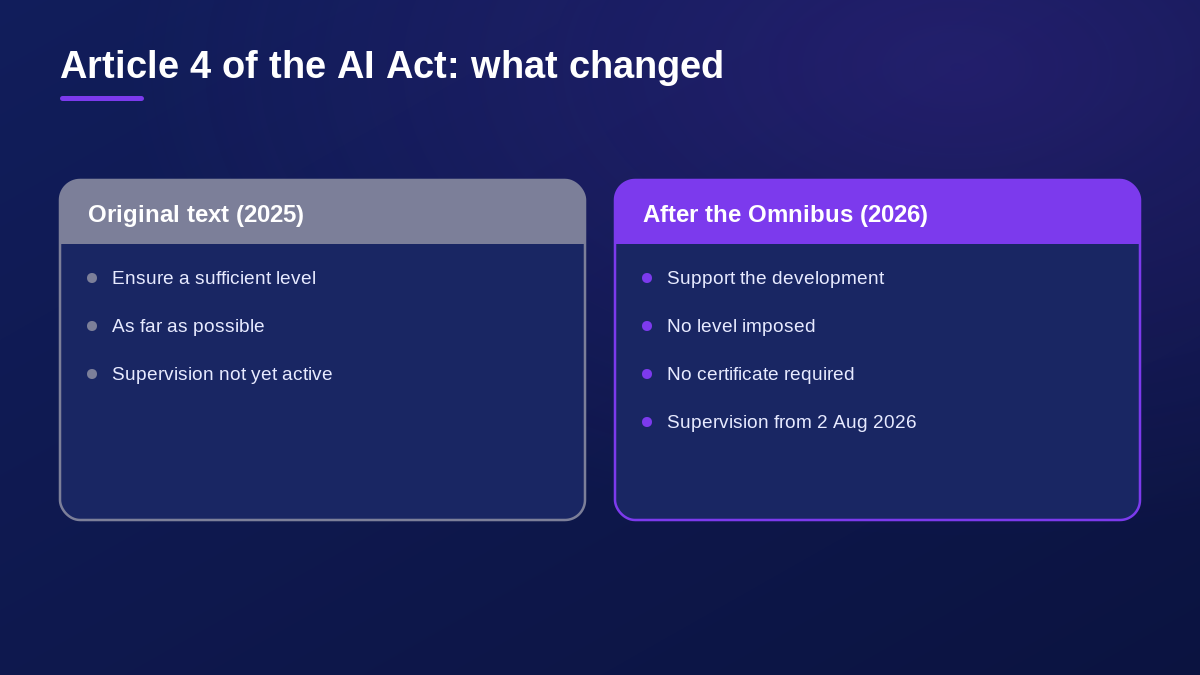
The new text also provides for the Commission and member states to support organisations, for example with practical examples. The official text is on the regulation's page on EUR-Lex; for interpretation, the Commission's questions and answers on AI literacy are the most useful document.
What Article 4 does not say
Much of the confusion comes from what the article does not require. From the Commission's questions and answers:
- No certificate is needed. To show you have acted, you can keep an internal record of training and other initiatives.
- You do not have to test every employee's knowledge.
- It does not impose the same programme on everyone. Training should be matched to staff background and to the context and risks of the systems in use. Handing out the instructions for use is generally not enough on its own.
- It does not cancel the duties of people who use high-risk systems. Deployers of those systems must still assign human oversight to people with adequate competence, training and authority (Article 26).
In practice: the obligation is real but flexible. It asks for something reasonable and documentable, not a rigid formality.
Where Article 4 sits in the AI Act
AI literacy is only one piece of a regulation that works by risk level. Since 2 February 2025 it has applied alongside the prohibited practices, such as emotion recognition at work and social scoring. From 2 August 2026 the general rules and the transparency duties arrive, and high-risk obligations follow on 2 December 2027 and 2 August 2028. For the full picture, read our guide to the EU AI Act.
The AI Act applies directly in every member state, but each country designates its own authorities and sets its own penalties. Member states can also add national rules on top, so it is worth checking whether your country has added anything that affects you as an employer.
Penalties: what you really risk
On this topic the tone is often alarmist, and it is worth keeping your feet on the ground.
For Article 4, the Commission states that enforcement is entrusted to national market surveillance authorities, which from 2 August 2026 can take measures and impose penalties under national law. Any penalty must be proportionate and assessed case by case. The Commission notes that missing training is more likely to lead to consequences when an incident occurs: in other words, the real risk is not a blanket audit of your course register, but having no measure at all when something goes wrong. The regulation also creates no criminal offences and no right to compensation: anyone harmed can act through the routes provided by national law.
The practical conclusion is simple: the risk is not "getting caught without a certificate", it is never having done anything. A documented, proportionate measure that fits the tools you use is the best defence.
Who needs training and on what
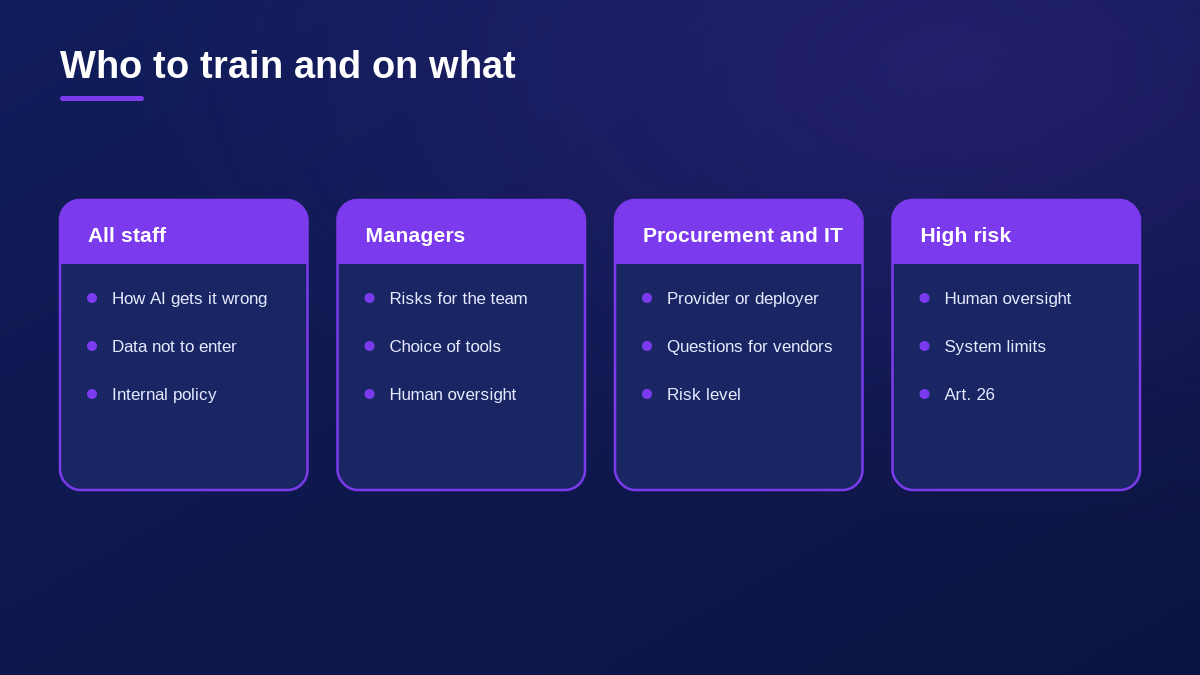
Article 4 speaks of staff and other people using the systems on the organisation's behalf: employees, but also contractors and consultants working with your tools. The content should be adapted to the role.
| Role | What they need to know |
|---|---|
| All staff who use AI | How assistants work and get things wrong, which data not to enter, when to verify, the internal policy |
| Managers and team leads | Risks for the team, choosing tools, when human oversight is needed, transparency towards customers and colleagues |
| People who buy or configure AI systems | Provider and deployer roles, questions to ask vendors, sorting uses by risk level |
| People who oversee high-risk systems | Specific human-oversight skills, the system's limits, how to intervene (Article 26) |
| People in security and privacy | How it fits with GDPR and other policies, incident handling |
How to comply in 5 steps
- Map the systems. List the AI tools in use, including the ones individuals have adopted on their own, and for each one who uses it and for what.
- Identify the roles. For each group of people, ask how exposed they are and to which risks, using the table above.
- Choose a proportionate programme. For most offices: a common base on how the tools work, their limits and responsible use, plus deeper modules for people with responsibilities.
- Keep a record. A table with date, participants, content, materials and owner. It is the kind of evidence the Commission describes as reasonable.
- Update. Tools and rules change every few months. Review the map and the content at least once a year, and whenever you introduce a new tool.
If you need a starting point for the policy, the privacy and company-data advice that applies to any organisation is a good place to begin: never paste confidential or personal data into a tool the organisation has not approved.
Frequently asked questions
Is AI training mandatory?
Yes, in a flexible form. Article 4 of the AI Act asks providers and deployers to take measures to support the AI literacy of their staff; it does not impose a programme or a specific level. Member states may add national rules, so check what applies in your country.
What happens if I don't provide the mandatory training?
Supervisory authorities can take measures and impose penalties under national law, in a way proportionate to the case. The Commission notes that missing training weighs most when an incident occurs. The AI Act creates no specific criminal offence. For your concrete case, ask a professional for advice.
Which AI systems are banned under the AI Act?
Among the prohibited practices, in force since 2 February 2025, are manipulation that exploits people's vulnerabilities, social scoring, emotion recognition at work and in schools (except for medical or safety reasons), and untargeted scraping of facial images. From 2 December 2026, systems that generate non-consensual intimate images and child sexual abuse material are added. The full picture is in our guide to the EU AI Act.
Do I need a certificate to prove AI literacy?
No. According to the Commission's questions and answers, no certificate is needed: an internal record of training and other initiatives can be enough to document the measures you have taken. A certificate of completion is still useful as evidence, but the rule does not require it.
What are the best AI courses for the AI Act?
No course meets a legal obligation on its own: what matters is that the training fits the roles and tools you actually use, and that it is documented. Look at the content, whether it is up to date with the current rules (Article 4 after the Omnibus), practical exercises, and whether the programme can be adapted to your organisation.
Next step
The AI training obligation has not disappeared, but it has become more reasonable: it asks you to support the competence of the people who use these tools, proportionately, and to be able to show it. The best way to meet it is to stop thinking of it as a formality and start from an honest map of what you use and who uses it.
If you want a programme built for this, the AI Act course on staff literacy helps companies and public bodies build an inventory of uses, a literacy plan and a usage policy, in plain language. The course is currently taught in Italian only; the course page describes what it covers. Like any course, it does not meet a legal obligation by itself: it is one of the measures you can choose to adopt. For individuals who simply want to understand and use AI better, there is the free Understanding AI: the fundamentals course, also currently taught in Italian only.