
Using ChatGPT at work? The EU AI Act already applies to you
Someone in your office summarises meeting notes with ChatGPT. A colleague makes social media images with a generator. HR is evaluating software that filters CVs. None of you build artificial intelligence, yet the EU AI Act, the European regulation on AI, has something to say about all three situations.
The trouble is that most of what you read online is out of date. Many articles date from the 2024 approval and quote deadlines that have since moved: in July 2026 the Digital Omnibus came into force, pushing back the high-risk dates and rewriting the staff-training obligation.
This guide gives you the current picture in plain language, from the point of view of someone who uses AI in a company or an office. It is informational and not a substitute for legal advice.
What you will learn:
- What the AI Act is and what it is for
- The four risk levels, with examples from office work
- The difference between a provider and a deployer, and which one you are
- The dates that matter after the Digital Omnibus
- What to do now, as a six-step checklist
Updated 23 November 2026. Sources: consolidated text of Regulation (EU) 2024/1689 on EUR-Lex and the European Commission's AI Act pages.
In brief
- The AI Act is Regulation (EU) 2024/1689. It regulates AI systems according to the risk they pose to health, safety and fundamental rights.
- Prohibitions and the staff AI literacy obligation have applied since 2 February 2025. The general rules, including transparency duties, apply from 2 August 2026.
- The Digital Omnibus (Regulation (EU) 2026/1744, in force since 27 July 2026) postponed high-risk obligations to 2 December 2027 and 2 August 2028.
- If you use AI tools in your job you are a deployer: your obligations are lighter than a provider's, but they are not zero.
- Each member state adds national rules on top, such as designated authorities and penalties, so check what applies where you operate.
What the AI Act is and what it is for
The AI Act is the European Union's regulation on artificial intelligence. It was published in the Official Journal of the EU on 12 July 2024 and has been in force since 1 August 2024. Because it is a regulation, it applies directly in every member state without needing national legislation to transpose it.
Its main goal is to make trustworthy AI circulate in Europe: protecting health, safety and fundamental rights without blocking the people who build and use these tools. To do that, it does not treat all AI the same way. It takes a risk-based approach: the more harm a use can do to people, the heavier the obligations.
One useful clarification: the AI Act does not regulate technology in the abstract, it regulates uses. The same language model can write an email (minimal risk) or filter candidates for a job (high risk). If you need a refresher on how these models work, start with what generative AI is.
The four risk levels
The European Commission describes the regulation in four levels. It is the framework to keep in mind, because almost every obligation flows from it.
| Level | What it means | Examples |
|---|---|---|
| Unacceptable risk | Prohibited practices | Emotion recognition on employees at work, social scoring, manipulation that exploits vulnerabilities |
| High risk | Allowed, with strict obligations | Software that screens CVs or evaluates employees, credit scoring, admission to education |
| Transparency risk | Duty to disclose the AI | Chatbots talking to customers, deepfakes, generated content |
| Minimal risk | No specific obligations | Spam filters, spellcheckers, most office uses |
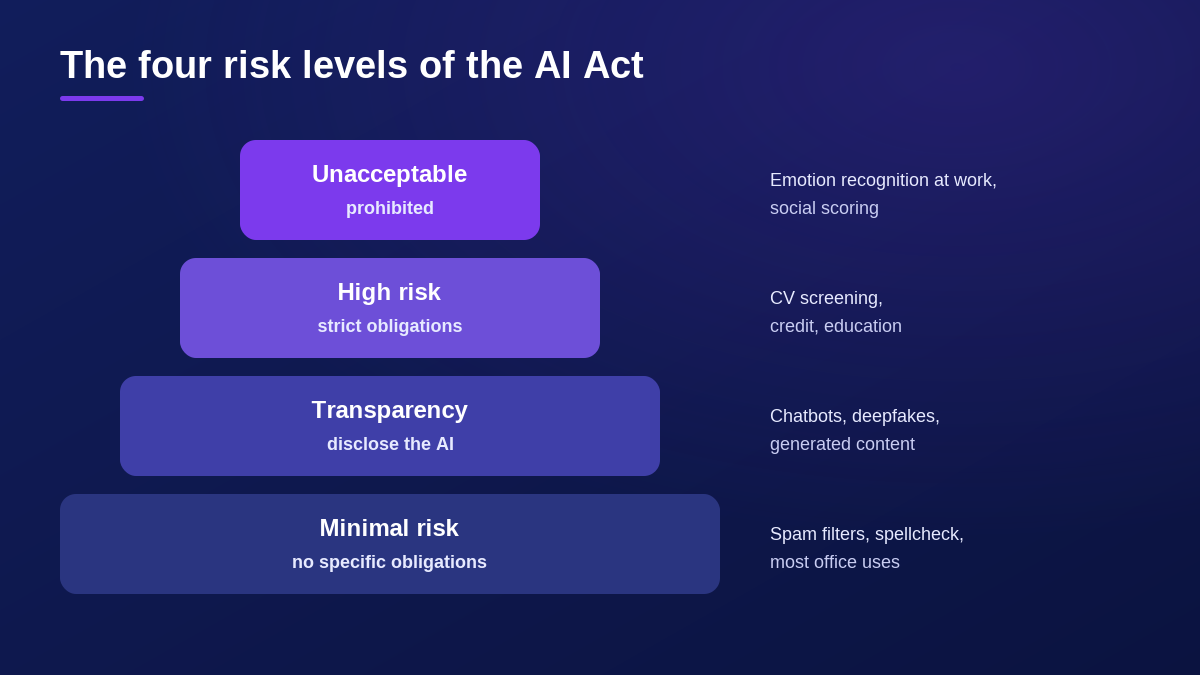
Two cases deserve attention because they touch the office. The first is emotion recognition in the workplace, prohibited since 2 February 2025 except for medical or safety reasons: software that "measures the stress" of employees from their messages falls here. The second is recruitment: a system that analyses or filters applications is not banned, but it is high risk, with obligations from 2 December 2027.
The Digital Omnibus added two new prohibitions, applicable from 2 December 2026: systems that generate realistic intimate images of identifiable people without their consent, and systems that generate child sexual abuse material.
Provider or deployer: which one are you?
The AI Act spreads obligations across different roles. These are the two that matter for a company.
The provider is whoever develops an AI system (or has it developed) and places it on the market under their own name or trademark. OpenAI, Anthropic, Google and Microsoft are providers of their assistants. The heaviest part falls on them: technical documentation, risk management, marking of generated content.
The deployer is whoever uses an AI system under their own authority for a professional activity. If your company uses ChatGPT, Microsoft Copilot or a recruitment tool, it is a deployer. A person using AI for personal, non-professional purposes is not a deployer.
Mind the boundaries: a company that configures a chatbot and puts it online under its own name may be treated as the provider of that system. That is a point to assess case by case with a lawyer.
The dates that matter (updated for the Digital Omnibus)
The original timetable had high-risk rules applying from 2 August 2026. Regulation (EU) 2026/1744, the so-called Digital Omnibus on AI, was published in the Official Journal on 24 July 2026 and has been in force since 27 July 2026. Here are the updated deadlines:
- 1 August 2024: the AI Act enters into force.
- 2 February 2025: definitions, prohibited practices (Art. 5) and staff AI literacy (Art. 4) apply.
- 2 August 2025: rules on general-purpose AI models, governance and penalties.
- 27 July 2026: the Omnibus enters into force, with the new text of Art. 4.
- 2 August 2026: general application, including the Art. 50 transparency obligations. National authorities begin supervising.
- 2 December 2026: the Omnibus's new prohibitions apply; deadline for providers of generative systems already on the market to mark content in a machine-readable way.
- 2 December 2027: obligations for Annex III high-risk systems (employment, education, credit, essential public services).
- 2 August 2028: obligations for high-risk AI built into regulated products such as toys, lifts and medical devices (Annex I).
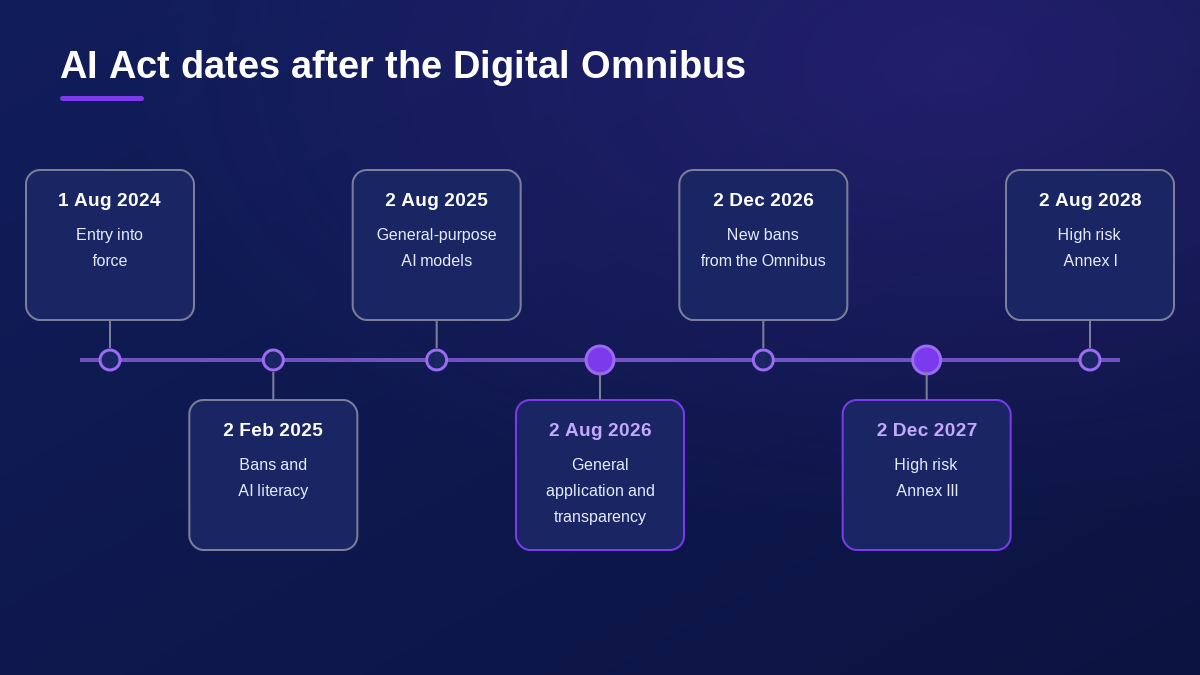
The dates come from the European Commission's AI Act page and the consolidated text on EUR-Lex. If you read articles that put high-risk obligations "from 2 August 2026", they are out of date.
What changes for companies that use AI
For most offices the AI Act does not mean heavy bureaucracy. It means three concrete things: being transparent in some cases, training people and, if you use high-risk systems, getting ready for 2027.
Transparency and generated content (Art. 50)
Transparency rules apply from 2 August 2026. People interacting with a chatbot must know they are talking to an AI unless it is obvious: that duty falls on the provider of the system. For deployers, two cases matter most:
- if you publish a deepfake (an image, audio or video that looks authentic), you must disclose that it is artificially generated or manipulated; for clearly artistic or satirical works, an appropriate form of disclosure is enough;
- if you publish AI-generated text to inform the public on matters of public interest, you must disclose it, unless it has been through human review under editorial responsibility.
A sales email or an internal draft written with AI does not fall under these obligations.
Staff AI literacy (Art. 4)
This is the obligation that concerns almost every company. The original text asked organisations to ensure "a sufficient level" of AI literacy. Since 27 July 2026, the text rewritten by the Omnibus asks providers and deployers to take measures to support the development of AI literacy among the staff who use these systems, and makes clear it does not require guaranteeing a specific level.
The Commission's Q&A clarifies two points: no certificate is needed, and the organisation can keep an internal record of training. The minimum content makes sense: anyone using ChatGPT at work should know its specific risks, such as hallucinations. According to the Commission, national authorities supervise this obligation from 2 August 2026.
National rules on top
The AI Act applies directly across the EU, but each member state designates its own supervisory authorities, sets penalties and may add rules, for example on informing workers. Check the national rules of every country where you operate.
What to do now: a 6-step checklist
- Take inventory. List the AI tools used in the company, who uses them and for what, including those colleagues use on their own initiative.
- Classify each use. For each one, ask: is it prohibited, high risk, subject to transparency, or minimal risk?
- Stop what is prohibited, right away. For example, software that infers employees' emotions.
- Write a usage policy. Which tools are allowed, which data must never be entered, when a generated content must be disclosed.
- Train people and keep a record. Training focused on the risks of the tools they actually use, with an internal record of who completed it.
- Prepare for 2027. If you use systems to select or evaluate staff, ask the vendor how it is adapting and plan for human oversight.
Common mistakes to avoid
- Thinking it only concerns developers. Anyone using AI for work is a deployer with obligations of their own.
- Confusing the AI Act with GDPR. They apply together: the AI Act does not replace the rules on personal data.
- Using old dates. High risk does not apply from 2 August 2026: it has slipped to 2027 and 2028.
- Believing you need an "official" certificate. For Art. 4 the Commission says no certificate is required.
- Treating Art. 4 as repealed. The Omnibus rewrote it, it did not delete it.
Frequently asked questions
When does the AI Act come into force?
The AI Act has been in force since 1 August 2024, but it applies in stages. Prohibitions and AI literacy from 2 February 2025, general-purpose models from 2 August 2025, the general rules and transparency from 2 August 2026. High risk arrives on 2 December 2027 and 2 August 2028.
Which practices does the AI Act prohibit?
Among others: manipulation that exploits people's vulnerabilities, social scoring, emotion recognition at work and in schools (except for medical or safety reasons), and untargeted scraping of facial images to build databases. From 2 December 2026, systems that generate non-consensual intimate images or child sexual abuse material are also banned.
What is the main goal of the AI Act?
To make sure AI used in Europe is safe and respects fundamental rights, without holding back innovation. It does so with obligations proportionate to risk: none for minimal-risk uses, strict rules for high-risk ones, and a ban for unacceptable ones.
What changes with the Digital Omnibus?
Regulation (EU) 2026/1744, in force since 27 July 2026, postponed high-risk obligations to 2 December 2027 (Annex III) and 2 August 2028 (Annex I), rewrote the Art. 4 AI literacy obligation, added two prohibitions and simplified some requirements for SMEs.
Does the AI Act apply to small businesses that use ChatGPT?
Yes. A company that uses ChatGPT for work is a deployer: it must take measures to train the people who use it and follow the transparency rules when it publishes deepfakes or text on matters of public interest. For common office uses the obligations are limited, and for SMEs the maximum fines are calculated more favourably.
Next step
The AI Act does not ask people who use AI to become lawyers. It asks them to know which tools they use, stay clear of the prohibitions, be transparent where required and train their people. With the Omnibus, 2026 is the year of transparency and training, while 2027 will be the year of high risk.
If you want to turn this checklist into a concrete plan for your organisation, EULE Institute offers an AI Act course for organisations: what the regulation really asks, how to build the inventory of uses, the literacy plan and the internal policy. The course is currently taught in Italian only; the course page describes what it covers. For a wider look at AI at work, see the artificial intelligence program.