Open a job listing from almost any tech scale-up and the design role is probably called product designer, not UX designer. Is that just a trendier label, or is there a different job behind it? The short answer: it is a broader responsibility. A product designer follows a digital product over time, from defining the problem to what happens after release, and is accountable for results as well as for the quality of the interface.
In this guide I explain what a product designer does, how the role differs from UX and UI design, which skills you really need, what the role pays in the US and UK, and how to get into it, whether you are coming from UX or starting from scratch.
What you'll learn:
- What digital product design is (and why it is not industrial design)
- What a product designer does at each stage of working on a product
- The concrete differences between product, UX and UI designers
- The design, product and collaboration skills the role requires
- What product designers earn in the US and UK, with up-to-date sources
- How to become one and what to put in your portfolio
What is product design (digital, not industrial)
First, a clarification, because the confusion is common. For decades "product design" meant industrial design: chairs, lamps, appliances, physical objects made for mass production. Search for "product designer" and you will still find industrial design studios and degrees in product design. They are perfectly respectable professions, but they are not what this article is about.
In the digital world, product design means designing a software product (an app, a SaaS platform, an internal tool, an online store) as a system that lives and changes. A product designer does not hand over a project and move on to the next client: they work inside a product team, on the same product, for months or years.
That difference in time horizon changes everything. A project has a start and an end. A product has versions, metrics, users who complain, features to remove and design debt to pay back. So product designers think less in terms of "screens" and more in terms of outcomes: how many people complete onboarding, how many errors a flow produces, how long it takes to reach value.
The work usually happens in what many companies call a product trio: a product manager, a tech lead and a product designer who decide together what to build, how and why. The designer brings the voice of the users and the quality of the experience to that table.
What a product designer does, day to day
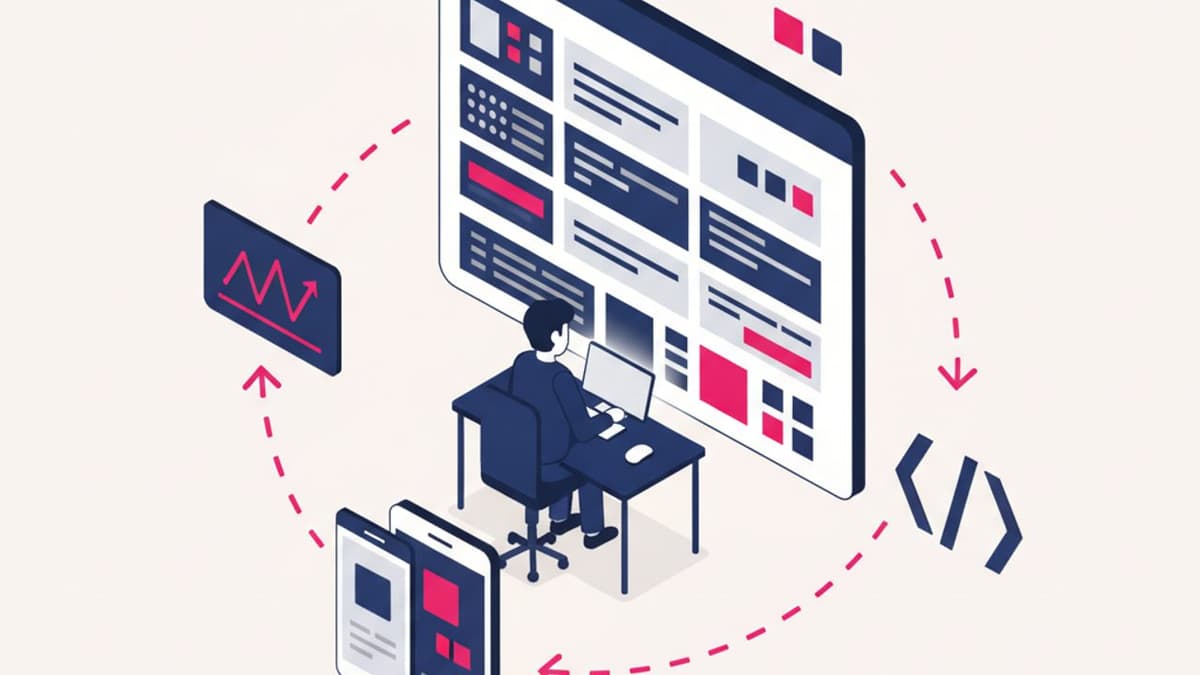
There is no single typical day, because it varies by company, but the work revolves around three phases that repeat in continuous cycles.
Discovery and problem definition
Before drawing anything, a product designer has to understand which problem is worth solving. They read usage data, listen to customer support calls, take part in user interviews, and collect and filter requests from sales. Tools such as the Kano model or the Jobs to Be Done framework help separate what users ask for from what they actually need.
The output of this phase is not a mockup but a clear definition: who has the problem, when it appears, and how we will know we have solved it.
Design, prototypes and systems
Then comes the design itself: flows, wireframes, interactive prototypes, user testing. Up to here the work looks a lot like a UX designer's. The difference is that a product designer designs inside an existing system: every new feature has to use the components of the design system, respect the design tokens, and cover every interface state (empty, loading, error, success) and edge case. What happens if the name is extremely long? If the user is offline? If they lack permission?
People who have only worked on portfolio projects often underestimate this part. In real products, edge cases are where most problems come from.
Metrics, experiments and iteration
The work does not end at release. The product designer looks at how the feature is actually used, compares the numbers with the original goal, designs variants to test in an A/B test, and decides with the team whether to iterate, keep or remove it. This is the part that most sets the role apart: the designer shares responsibility for the result, not just the delivery.
Product designer vs UX designer vs UI designer: the differences
The three titles overlap a lot, and many companies use them interchangeably. But if you look at the scope of responsibility, there are differences.
| UX designer | UI designer | Product designer | |
|---|---|---|---|
| Guiding question | Is the experience useful and usable? | Is the interface clear, consistent and polished? | Does the product solve the problem and deliver results? |
| Focus | Research, flows, information architecture | Visual design, typography, components, details | The whole experience, the system and metrics |
| Time horizon | Often a single project | A single project or the design system | The product over time, before and after release |
| Works mostly with | Users, researchers, the client | UX designers, front-end developers | Product managers, developers, data |
| Measures success with | Usability tests, feedback | Consistency, visual quality | Product metrics and experiments |
In practice, a product designer almost always covers both the UX and the UI side, with a product mindset on top. It is not a "senior" version of the other roles: a senior UX researcher has research skills a generalist product designer will never match. It is a wider role, built for teams where each designer owns an area of the product from start to finish. To see how these roles fit together in teams of different sizes, read our guide to UX design team roles, and for the UX designer's work in detail, what a UX designer does.
The skills you need
A product designer's skills fall neatly into three families. Nobody arrives in the role strong in all three, but you need at least a baseline in each.
Design skills: design systems, tokens, states and edge cases
The starting point is the basics of UX and UI: research, information architecture, interaction design, visual hierarchy, prototyping in Figma. On top of that comes the ability to work systematically: using and growing a design system, thinking in components and variants, documenting a decision so someone else can reuse it. And then states: a product designer delivers the complete flow, including errors, missing permissions and absent data, not just the happy path.
Accessibility matters too. With the European Accessibility Act in force since 28 June 2025, many digital products sold in the EU must meet accessibility requirements, and anyone designing components needs to know WCAG 2.2: contrast, focus, reading order, keyboard navigation.
Product skills: metrics, A/B tests, prioritization
This is the main difference from a classic UX path. A product designer needs to read a dashboard, know what an activation or retention rate is, write a measurable hypothesis and recognize when an A/B test has produced a reliable result. UX metrics are the first step; business metrics are the second.
You also need to be able to prioritize: with limited resources, which problem do you tackle first? The designer does not decide alone, but has to argue with data and research, not personal taste.
Collaboration: developer handoff and working with the product manager
A product designer spends a lot of time with developers. You do not need to code, but you do need to understand how a front-end component is built, what a design choice costs in development, and how to write usable specs. You also need design QA: checking that what was built matches what was designed before it reaches users.
With the product manager the relationship is one of close collaboration. The PM owns the "what" and the "why" at the business level; the designer owns the "how" at the experience level. In teams that work well, the boundaries are porous and decisions are made together.
Finally, more and more often, AI features. Designing an assistant, an automatic summary or a smart search calls for new interface patterns: how to show uncertainty, how to let the user correct the output, how to handle the model's mistakes.
How much does a product designer earn?
Public salary data for product designers is limited and comes mostly from tech companies, so read it with caution. As of late November 2026, Levels.fyi reports a median total compensation (base, bonus and equity) of about $170,000 a year in the United States, with half of the reports falling between roughly $111,000 and $235,000, from about 1,500 submissions. For the United Kingdom, the median is about £74,800, with a middle range of roughly £58,500 to £91,000, from about 110 submissions.
Keep in mind that these samples lean toward large tech companies and well-paid roles, so they sit above what you will find at agencies or small businesses. Seniority, city, industry and remote contracts move the numbers a lot. For detailed ranges by level, region and sector, see our guide to UX designer salaries.
How to become a product designer, from UX or from scratch
There is no mandatory degree and no professional register. You get into the role through demonstrated skills, and there are two common routes.
If you start from UX. This is the most natural path. You already have the basics of research, flows and prototyping; what you usually lack is systematic work and the product side. What to do:
- Work on a real design system, even a small one: tokens, components, variants, documentation.
- Learn to read the metrics of the product you work on, and ask to take part in setting its goals.
- Design a complete flow with every state and edge case, not just the main path.
- Sit with developers during implementation and do design QA.
If you start from scratch. Product design is not an entry point: it is the next step. First you need the basics of UX and UI, then some experience on real projects, then specialization. Skipping the first step produces designers who know the vocabulary of product but cannot run a usability test. The sensible route is to build the foundations (research, interaction design, visual design, Figma) and only then move toward product.
Either way, the thing that speeds you up most is working on a living product: a company, a startup, an open-source project, even a side project with real users. That is where you learn to iterate after launch.
The product designer portfolio: what to show
A product designer's portfolio is not a gallery of beautiful screens. Whoever is hiring wants to understand how you think. A good product case study shows:
- The problem and the context: who the users were, what was not working, what constraints existed.
- Your role: what you did and what the team did.
- Decisions and trade-offs: which alternatives you rejected and why.
- The system: how the solution fits into the design system, which states you covered.
- The result: what changed after release, with numbers when you have them and honesty when you don't.
Two or three in-depth cases are worth more than ten shallow projects. For structure, platforms and mistakes to avoid, read the guide on how to build a UX portfolio online.
Frequently asked questions
What is the difference between a product designer and a UX designer?
A UX designer focuses on the user experience: research, flows, usability. A product designer usually covers both UX and UI and also works on the product over time, with metrics, experiments and iteration after release. At many companies the two titles describe very similar jobs: the scope of responsibility matters more than the name.
Does a product designer need to know how to code?
No. But you do need to understand how front-end development works: what a component is, how a responsive layout behaves, what makes a choice expensive. Reading a little HTML and CSS helps a lot in conversations with developers and in design QA, but it is not a requirement for the role.
Is product design a well-paid job?
It sits at the upper end of design roles. In late November 2026 Levels.fyi reports a median total compensation of about $170,000 in the US and about £74,800 in the UK, from samples that lean toward tech companies. Pay depends heavily on seniority, industry and the type of company.
What qualifications or backgrounds do you need to become a product designer?
None is mandatory. Many product designers come from communication design, psychology, computer science or entirely different paths. What counts is the skill you can show in your portfolio: solid UX and UI foundations, experience on real products, and the ability to work with data and developers. Structured training shortens the road, but it does not replace practice.
Product designer and product manager: who decides what?
As a rule, the product manager owns the "what" and the "why" (priorities, business goals, roadmap) and the product designer owns the "how" (the experience and the solution). In practice the best decisions are made together, in the product trio with the tech lead: the designer brings research and experience quality, the PM brings business context, and the tech lead brings feasibility.
Next steps
If you already know UX and want to take the step toward product, EULE Institute's Product Design course is built for exactly that. It has 8 modules and a final portfolio project with mentor review, 100% online. You work on design systems and tokens, states and edge cases, B2B products, metrics and experiments, developer handoff, AI features and component accessibility, all through a single teaching case. The English edition is still in preparation, and its start date, price and enrolment terms are yet to be confirmed.
If you are starting from zero, the first step is the complete path to becoming a UX Designer: the foundations on which you build a product specialization.
To go deeper:
- What a UX designer does: the role most product designers start from
- Design systems: the complete guide: the foundation of systematic product work
- Design states: how to design empty, loading, error and success
- A/B testing: how to test a design variant with data