
The filter that moves an email into spam, the app that suggests your next film, the phone that transcribes what you say, ChatGPT answering a question. Behind almost all of these there is the same ingredient: a system that was not programmed with hand-written rules, but that has learned from data. When people talk about it, though, two expressions come up that look like synonyms and are not: machine learning and deep learning.
In this guide we look at what they mean, how machine learning and deep learning differ (the classic "machine learning vs deep learning" question) and where you meet them every day, with concrete examples and no formulas. The text is written for people who work in an office, study, or are simply curious, not for those who need to write code.
What you'll learn:
- What machine learning is and how you get from data to a model
- What neural networks are and what makes deep learning "deep"
- The three main types of learning
- The difference between machine learning and deep learning, with a table and two examples
- Where ChatGPT and generative models fit into the picture
Updated on 23 November 2026. Sources: the research papers cited in the text (Samuel 1959, Rumelhart, Hinton and Williams 1986, Krizhevsky, Sutskever and Hinton 2012, LeCun, Bengio and Hinton 2015).
In brief
- Machine learning is the set of methods by which a system learns from examples instead of following rules written by a person.
- Deep learning is a type of machine learning based on neural networks with many layers: it suits images, audio and text.
- They are not competitors: deep learning sits inside machine learning, which in turn sits inside artificial intelligence.
- On data in table form, such as the data in a business management system, classic methods are often still the best choice.
- ChatGPT, Claude and Gemini are deep learning models specialised in language: large language models.
What is machine learning
Machine learning is the approach in which a program gets better at a task through experience, that is, through data, without anyone writing a rule for every case.
Think of a spam filter. The "traditional" way would be to write rules: if the email contains word X, it is spam. It works for a while, then spammers change the word. With machine learning you do the opposite: you show the system thousands of emails already labelled as spam or not spam, and the system works out for itself the clues that tell one from the other. When a new email arrives, it applies what it has learned.
The name has a birth date you can cite. In 1959 Arthur Samuel, an IBM researcher, published in the IBM Journal of Research and Development the paper "Some Studies in Machine Learning Using the Game of Checkers", describing a checkers program that could improve by playing and end up playing better than the person who wrote it. It is one of the first demonstrations that a computer can learn from experience.
How a model is "trained"
The path is always the same. You collect examples (emails already labelled, photos with a description, sales histories). An algorithm looks for regularities in the data and stores them as numbers, the parameters: the result is the model. You test it on data it has never seen, to find out whether it has learned or merely memorised. Then you use it: it receives new data and produces a prediction, such as "this is spam" or "there is a cat in this photo".
One point to keep in mind: a model is only as good as the data it was trained on. Unbalanced or wrong data produces unbalanced or wrong predictions.
The three types of learning
To the question "how many types of machine learning are there?" the classic answer is: three. What changes is how the system receives information.
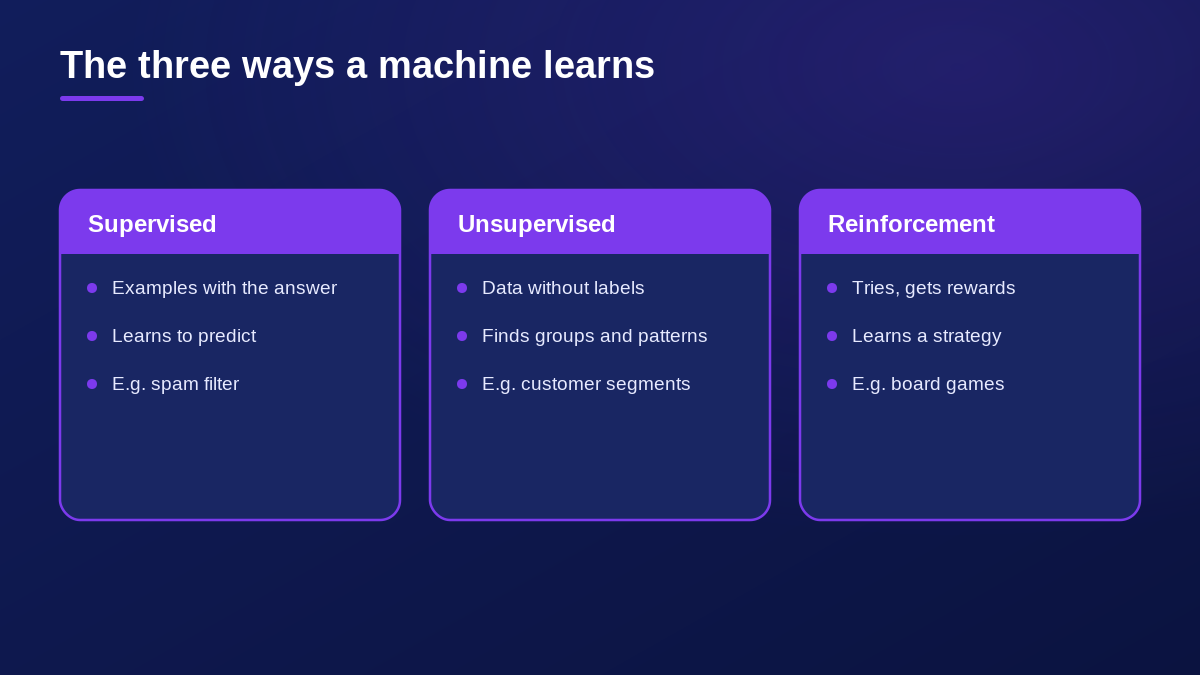
Supervised learning. The system learns from examples that already include the right answer, called a label. This is the case of the spam filter or of a model that estimates the price of a flat from its surface area, location and the age of the building. It is the most common type in business applications.
Unsupervised learning. The data arrive without labels and the system looks for groups and patterns on its own. A typical use is customer segmentation: nobody told the model which groups exist, it finds them by observing purchasing behaviour.
Reinforcement learning. The system acts in an environment, receives a reward or a penalty and learns a strategy that maximises the reward over time. It is the approach used for programs that learn to play games and for some robotics problems. It is also part of how conversational assistants are trained, when feedback from people steers the model towards better answers.
You will also come across self-supervised learning, in which the system derives the labels from the data itself: this is the pre-training of language models, which learn to predict the next word in existing texts.
What are neural networks
Artificial neural networks are a type of machine learning model inspired, in a very simplified way, by the brain. The comparison only helps up to a point: they are mathematical structures, not miniature brains.
A network is made of nodes (sometimes called "neurons") organised in layers. Each node receives numbers, multiplies them by weights, adds them up and passes the result to the next layer. The input layer receives the data, for example the pixels of an image; the intermediate layers, called hidden layers, process the information; the final layer produces the result, for example "cat" or "dog".
During training the network compares what it produced with the right answer and adjusts the weights to reduce the error, and it does this millions of times. The technique that made training networks with several layers practical is backpropagation, described in a paper by David Rumelhart, Geoffrey Hinton and Ronald Williams published in Nature in 1986. The idea of a neural network is also older than you might think: the perceptron, a single-layer network, dates back to 1958 with Frank Rosenblatt (Psychological Review).
The weights are the "parameters" you hear about when someone says a model has billions of them. If you want to see how this idea leads to models that write text, it is explained in what LLMs are.
What is deep learning
Deep learning is machine learning that uses neural networks with many hidden layers. "Deep" refers to the number of layers, not to the depth of the reasoning.
The idea, summed up in the paper by LeCun, Bengio and Hinton published in Nature in 2015, is that successive layers learn representations of the data at increasing levels of abstraction. In an image, for example, the first layers pick up edges and contrasts, the intermediate ones shapes and parts of objects, the last ones the whole object. Nobody tells the network to look for edges or shapes: it learns them on its own from the examples. This is the big difference from classic machine learning.
Why it exploded in the 2010s
Deep networks had existed for decades, but they worked well only under certain conditions: huge amounts of data and a lot of computing power. Both became available. The symbolic moment is 2012, when the AlexNet network by Alex Krizhevsky, Ilya Sutskever and Geoffrey Hinton (paper at NIPS 2012) won the ImageNet image-recognition competition with a top-5 error of 15.3%, against 26.2% for the runner-up. Since then deep networks have become the standard for images, speech, machine translation and, since 2017 and the transformer architecture, for language models.
Machine learning vs deep learning: the difference
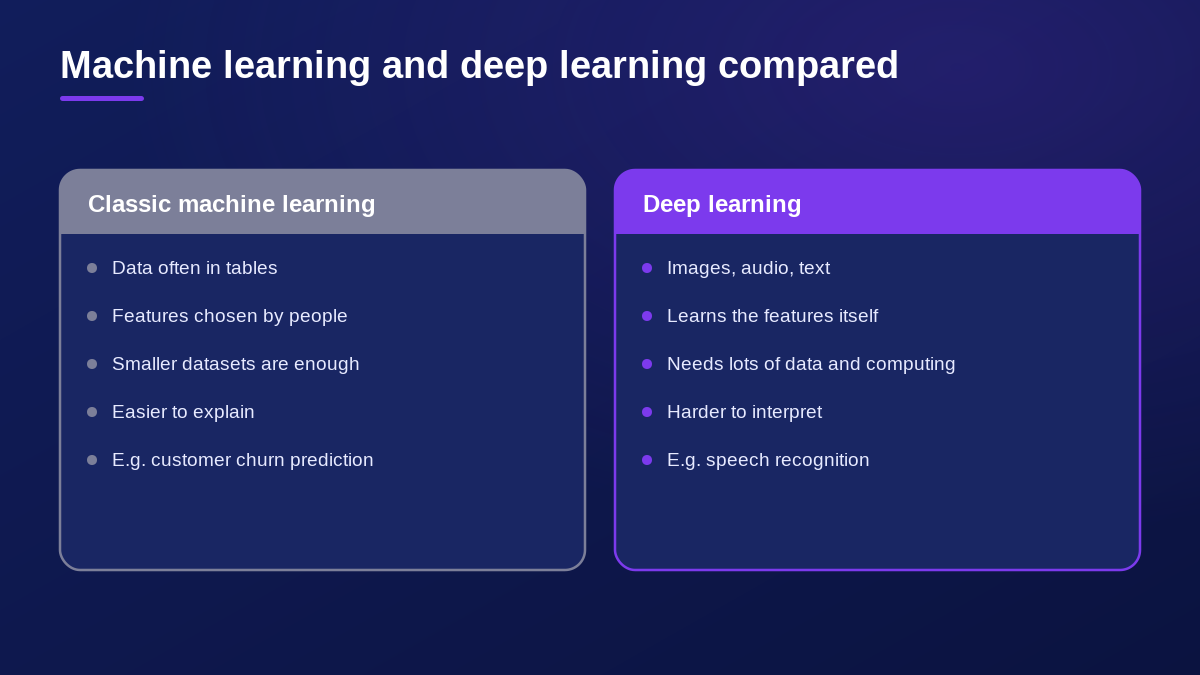
Deep learning is machine learning: it is its newest family and the most powerful for certain tasks. That is why the right question is not "which of the two is better?" but "which one does this problem need?".
| Aspect | Classic machine learning | Deep learning |
|---|---|---|
| How the useful information is extracted | The "features" are chosen by a person, for example age and average purchase amount | The network learns them on its own from raw data |
| Best-suited data | Structured data, in table form | Images, audio, video, text |
| Amount of data | Even a few thousand examples | Usually a great many |
| Computing required | Often an ordinary computer | Usually graphics processors (GPUs) or dedicated hardware |
| Explainability | Easier to see why it decided that way | Harder: often a "black box" |
| Examples | Customer churn prediction, price estimation, fraud detection | Speech recognition, face recognition, translation, conversational assistants |
A fact that surprises people who think "deeper" is always better: on data in table form, methods based on decision trees are often still competitive with, or better than, neural networks. It is shown, among others, by a study by Grinsztajn, Oyallon and Varoquaux presented at NeurIPS in 2022, which compared the two approaches on 45 tabular datasets.
Two examples to understand the difference
Predicting whether a customer will cancel a subscription. You have a table with one row per customer: how long they have been a member, how much they spend, how many times they have called support. The data are already structured and you choose the features: this is classic machine learning, and a simple model also tells you which factors weigh most.
Spotting a defect in a photograph of a mechanical part. Nobody can hand-write the features that tell a good part from a faulty one starting from pixels. This is deep learning territory: the network learns from the photos which visual patterns matter.
Where you meet them every day
In your email (spam filters), in shopping and streaming (recommendations), at the bank (suspicious transaction detection), on your phone (face unlock, voice dictation), in maps (traffic estimates), in machine translation and in assistants such as ChatGPT, Claude and Gemini. In healthcare they help read medical images, with the decision always left to the doctor.
Artificial intelligence, machine learning, deep learning: how they fit together
They are boxes inside one another. Artificial intelligence is the broadest field, and it also includes older systems based on rules written by experts, which do not learn from data. Machine learning is the part of AI that learns from data. Deep learning is the part of machine learning that uses deep networks. Generative models, which produce text, images or audio, are almost always built with deep learning.
What kind of artificial intelligence is ChatGPT?
ChatGPT is an assistant built on a large language model: a deep learning model with a transformer architecture, trained first in a self-supervised way on enormous amounts of text and then refined with examples and feedback from people. So it is, all at once, artificial intelligence, machine learning, deep learning and generative AI. What it can do and where it goes wrong is covered in What is an LLM and how it works.
Limits to know about
Knowing how a model learns helps you distrust it at the right moment. It depends on the data: if they represent part of reality badly, the model will get it wrong more often exactly there. It finds correlations, not causes. It produces probabilities, not truths, and can seem sure even when it is wrong. The bigger the network, the harder it is to explain why it gave that particular result. When a system of this kind affects people, for example in hiring, European rules set stricter controls: see our EU AI Act guide.
Common mistakes to avoid
- Using "deep learning" as a synonym for "artificial intelligence". It is a part, not the whole.
- Thinking you always need a neural network. For many business problems a simple model works better and is easier to explain.
- Confusing training with use. When you write to ChatGPT, the model does not learn from you at that moment: it applies what it has already learned.
Frequently asked questions
What is the difference between machine learning and deep learning?
Deep learning is a type of machine learning that uses neural networks with many layers. The practical difference is that in classic machine learning the useful features are chosen by a person and the data are often in table form, whereas in deep learning the network learns them on its own from raw data such as images, audio and text, usually with far more data and computing.
How many types of machine learning are there?
The three main ones are supervised learning (examples with the right answer), unsupervised learning (data without labels, to find groups and patterns) and reinforcement learning (trials, rewards and penalties). There is also self-supervised learning, where the labels come from the data themselves, as in the pre-training of language models.
What is the difference between artificial intelligence and machine learning?
Artificial intelligence is the general field covering every system capable of "intelligent" tasks. Machine learning is a part of it: the one in which the system learns from data instead of following hand-written rules. Every machine learning system is AI, but not all AI uses machine learning.
What are neural networks?
They are mathematical models made of nodes organised in layers, linked by weights that are adjusted during training. They receive input data, process it layer after layer and produce a result. They are the basis of deep learning.
The next step
Machine learning is the underlying idea: getting a system to learn from examples. Deep learning is its multi-layer version, which made possible image recognition, voice and today's language models. Knowing the difference lets you read AI news more calmly, and tell when a technology really suits a problem and when it is just fashionable.
If you want to go deeper with a guided path, the free course Understanding AI: the fundamentals takes you from the basics, neural networks included, to generative AI, with exercises, quizzes and a final certificate. The course is currently taught in Italian only; the English page has the details and lets you ask for information.