You type a question into a chat and a second later you get an answer in fluent English, well structured, in just the right tone. It feels as if someone is replying. What is actually replying is an LLM, and understanding what that is helps you use it better and know when not to trust it.
The acronym turns up everywhere, often without explanation: on vendors' websites, in the news, in company documents. Anyone meeting it for the first time usually has two questions. Is it the same thing as artificial intelligence? And how does a piece of software manage to write like this?
Here you will find answers in plain words, without formulas. For the more technical concepts we point to dedicated guides rather than repeat ourselves. The information on models was checked in November 2026.
What you will learn:
- What LLM stands for and which definition to keep in mind
- The difference between an LLM, artificial intelligence, machine learning and a chatbot
- How a model works: tokens, parameters, training and the context window
- The main models and who makes them
- What they can do and where they go wrong
In brief
- LLM stands for large language model: an artificial intelligence model trained on huge amounts of text to produce language.
- It works by predicting the next token: it does not look facts up in an archive, it calculates which continuation is most probable.
- Its "knowledge" lives in its parameters, the numbers adjusted during training; its working "memory" is the context window.
- ChatGPT, Claude and Gemini are assistants built on top of an LLM: the model is the engine, the assistant is the product.
- LLMs write well but can be confidently wrong, which is why their output needs checking.
What LLMs are: meaning and definition
An LLM is an artificial intelligence model trained on large amounts of text to understand and generate natural language. The name contains three clues.
Large refers to scale: a lot of training data and a huge number of parameters, in the leading models in the billions or more. Language, because the raw material is language. Model, because it is a mathematical model, not an archive of sentences: after training it holds no copies of the texts, only numbers that describe regularities in language.
The underlying technology is the transformer architecture, introduced in 2017 in the Google research paper "Attention Is All You Need". Its key idea, the attention mechanism, lets the model weigh how much each word in a text matters for interpreting the others. That is what lets it work out that in "Mark lent the book to Luke because he needed it", the "he" has to be resolved by looking at the whole sentence.
Watch out for a second meaning of the acronym: in law, "LLM" also stands for Master of Laws, the degree. Here we always mean language models.
LLM, AI, machine learning and chatbot: what is what
These terms are often used as synonyms, but they are boxes nested inside one another.
| Term | What it means | Example |
|---|---|---|
| Artificial intelligence | The field that studies systems able to do tasks that require intelligence | From image recognition to recommendation engines |
| Machine learning | The subset where the system learns from data instead of following hand-written rules | A spam filter that improves with examples |
| Deep learning | Machine learning with many-layered neural networks | Speech recognition |
| LLM | A deep learning model specialised in language | The models behind ChatGPT, Claude and Gemini |
| Chatbot / assistant | The product you talk to, built from an LLM plus an interface, rules and tools | ChatGPT, Claude, Gemini, Copilot |
So an LLM is a form of artificial intelligence, but not all artificial intelligence is an LLM. And a chatbot is not the same as the model: one LLM can sit behind very different products, and one product can change model over time. When an LLM is also given tools and goals, we enter the territory of AI agents, which our no-code AI agents course covers (it is taught in Italian).
The term natural language processing (NLP) refers to the branch of computer science that teaches computers to handle human language. LLMs are now the dominant approach within NLP.
How an LLM works
Tokens: how text becomes numbers
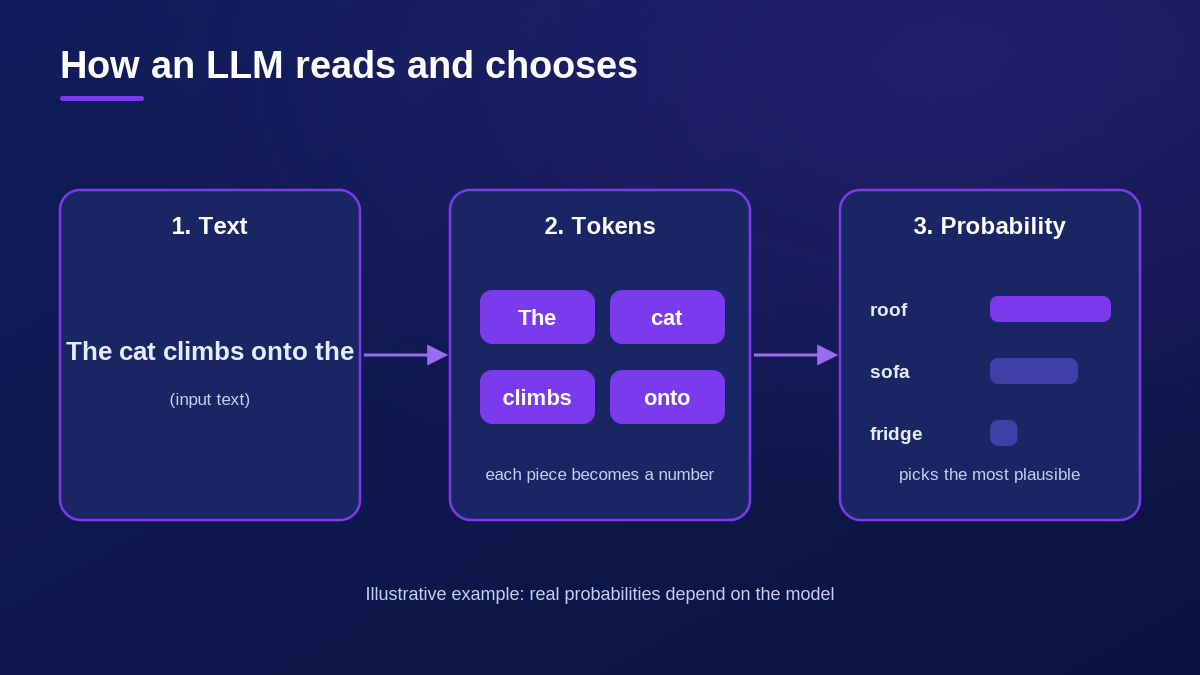
A computer does not read words, it reads numbers. First the text is split into tokens: fragments that can be a whole word, a syllable or a punctuation mark. Each token has an ID number, and those numbers are what the model works with.
This has practical consequences. Usage limits and costs of the services are often measured in tokens, not words. And languages with long words and many verb forms tend to need more tokens than English text with the same meaning, so a prompt in Spanish or German can use up your limits a little faster. At every step the model assigns a probability to all possible tokens and picks one: that is the whole mechanism, and it is enough to explain both how fluent it is and why it can be wrong.
Parameters and training
Parameters are the model's internal numbers. Before training they have random values; during training they are adjusted millions of times until the model gets good at predicting text. In the end they are what "contains" its knowledge of language and of the world. More parameters does not automatically mean a better model, but size remains one of the factors that determine its capabilities.
Training usually happens in three stages.
Pre-training. The model reads an enormous amount of text and learns to predict the next token. It is the most expensive stage, requiring huge amounts of computing power, and what comes out is a model that can write but cannot yet hold a useful conversation.
Fine-tuning. The model is trained further on selected examples, for instance well-made question and answer pairs, to learn to follow instructions.
Reinforcement learning from human feedback (RLHF). People rate alternative answers from the model and the system learns to prefer the better ones. It is the technique OpenAI described in its 2022 InstructGPT work, and it is part of what makes an assistant polite and useful rather than just fluent. Vendors also use variants and other techniques, often not described in detail in public.
The context window and "memory"
The model has no permanent memory of your conversations. What it "remembers" while answering is whatever sits inside the context window: the set of tokens it can consider at once, meaning your message, the chat history, any documents you attached and the system instructions.
The size of the window is a concrete limit. In current models it ranges from a few tens of thousands of tokens up to around a million in the largest ones: enough for entire books. When the conversation exceeds the window, the oldest parts are ignored or summarised. That is why in a very long chat an assistant can "forget" an instruction you gave at the start, and why it helps to start a new conversation with a summary.
The main LLMs in 2026
The landscape changes every few months, so instead of version numbers, which go out of date at once, here are the main families and how they differ. To decide which one to use, the most reliable test is to try two or three on a real piece of your own work.
| Family | Maker | Open or closed model | Where you meet it |
|---|---|---|---|
| GPT | OpenAI | Closed (OpenAI has also released some smaller open-weight models) | ChatGPT, the API, many third-party products |
| Claude | Anthropic | Closed | The Claude app, the API, Cowork and Claude Code |
| Gemini | Closed (Google separately publishes the open Gemma models) | The Gemini app, Google Workspace, Android | |
| Llama | Meta | Open weights, under a licence with some conditions | Local use, research, third-party products |
| Mistral | Mistral AI (France) | Some open models, others paid | The Le Chat app, the API, business use |
"Closed" means you use the model only through the maker's service. "Open" (more precisely, open weights) means you can download the parameters and run them on your own computers, within the licence terms. It is not the same as open source software in the strict sense: the licence and the availability of the training data vary.
Microsoft Copilot, which you find in office apps, is not a family of its own: it is an assistant that relies on models from different makers, as we explain in the guide to Microsoft Copilot. Anthropic's agent for office work, Claude Cowork, is described in a dedicated guide.
What they can do and where they go wrong
LLMs are very good when the task is made of language: writing and rewriting, summarising, translating, classifying, explaining, extracting information from a text, writing code. With connected tools they can also search the web or open files.
Their limits come from the way they work.
They can make things up. Because they produce the most plausible continuation, not the verified one, they can state false things in a confident tone: these are called hallucinations. They are more likely with precise data (figures, quotations, regulations, bibliographic references) and on poorly documented topics.
They have a training cut-off date. What they know stops at a certain point. Without web access they do not know later news.
They have no intentions and no experience. They do not "understand" in the human sense and do not know when they are wrong.
They depend on how you ask. The same request worded differently can give very different results, which is why prompt engineering matters.
The practical rule: use an LLM to produce drafts and to reason about material you give it, and always verify whatever you will use as a fact.
Open source and local LLMs: do you need one?
If you don't work with particularly sensitive data, probably not. Open-weight models can be run on your own computer or on a company server, without sending data to an outside provider. That is an advantage for privacy and control, and it can suit developers, companies with strict requirements and enthusiasts.
It comes at a price: you need adequate hardware (powerful machines for the largest models), you have to set up and update the system, and the most capable models are usually still the closed ones. For everyday use an assistant such as ChatGPT, Claude or Gemini is much simpler. Before choosing a local option, ask yourself which data you really cannot send outside: the answer is often "less than you think", but check it against your organisation's rules.
Frequently asked questions
What is the difference between an LLM and AI?
Artificial intelligence is the general field; an LLM is a specific type of AI model, specialised in language. Every LLM is a form of AI, but there are many AI systems that are not LLMs, such as those that recognise images or recommend a film.
What are the main LLMs?
The most widespread families are OpenAI's GPT, Anthropic's Claude, Google's Gemini, Meta's Llama and Mistral AI's Mistral. There are other makers too, and many open-weight models. Version numbers change often, so to find out which are the latest, check the makers' official pages.
How is an LLM developed?
In three main stages: pre-training on large amounts of text to learn to predict the next token, fine-tuning on examples of instructions and answers, and training with human feedback to make answers more useful and safer. It is a process that needs data, a great deal of computing capacity and a team of specialists.
How much does an LLM cost?
It depends what you mean. To use one, many assistants have a free plan with limits and monthly paid plans; if you build one into your own software you usually pay by usage, based on tokens. Developing one from scratch takes very large investments in computing and data, which is why the leading models are made by a handful of organisations. Prices change often, so check the makers' sites.
What is natural language processing?
It is the branch of computer science that gets computers to process human language: translating, summarising, answering questions, recognising the tone of a text. LLMs are now the most effective approach within this field.
The next step
An LLM is a model that has learned the regularities of language from enormous amounts of text and that, at each step, picks the most plausible token. Knowing this explains both why it writes so well and why it needs checking. It is not an oracle and it is not magic: it is a powerful tool with precise limits.
If you want to go beyond the definition and also understand neural networks and the rise of ChatGPT, the free course Understanding AI: the fundamentals takes you from the basics to generative AI, with exercises, quizzes and a final certificate. The course is currently taught in Italian only; the English page has the details and lets you ask for information.